
• Micromorts and Understanding the Probability of Death

    Understanding probabilities is hard (viz.) — and it’s especially so when we try to understand and take rational decisions based on very small probabilities, such as one-in-a million chance events. How, then, to communicate risks on a similar level, too?

    The answer is to use a more understandable scale, such as micromorts; “a unit of risk measuring a one-in-a-million probability of death”. Some activities that increase your risk of death by one micromort (according to, among other sources, the Wikipedia entry):

    • smoking 1.4 cigarettes (cancer, heart disease)
    • drinking 0.5 liter of wine (cirrhosis of the liver)
    • living 2 days in New York or Boston (air pollution)
    • living 2 months in Denver (cancer from cosmic radiation)
    • living 2 months with a smoker (cancer, heart disease)
    • living 150 years within 20 miles of a nuclear power plant (cancer from radiation)
    • drinking Miami water for 1 year (cancer from chloroform)
    • eating 100 charcoal-broiled steaks (cancer from benzopyrene)
    • eating 40 tablespoons of peanut butter (liver cancer from Aflatoxin B)
    • eating 1000 bananas, (cancer from radioactive 1 kBED of Potassium-40)
    • travelling 6 miles (10 km) by motorbike (accident)
    • travelling 16 miles (26 km) on foot (accident)
    • travelling 20 miles (32 km) by bike (accident)
    • travelling 230 miles (370 km) by car (accident)
    • travelling 6000 miles (9656 km) by train (accident)
    • flying 1000 miles (1609 km) by jet (accident)
    • flying 6000 miles (9656 km) by jet (cancer from cosmic radiation)
    • taking 1 ecstasy tablet

    Issue fifty-five of Plus magazine looked at micromorts in more detail, thanks to David Spiegelhalter (the Winton Professor of the Public Understanding of Risk at the University of Cambridge) and Mike Pearson, both of Understanding Uncertainty.
    via Schneier on Security

  • The Drinkers’ Bonus: Alcohol Intake and Increased Earnings

    Drinking alcohol — and the increased social capital that it leads to — may not just be responsible for a possible increase in life span; it may increase your earnings, too.

    In an analysis of both the General Social Survey and the published literature, researchers for the Reason Foundation show that alcohol drinkers earn, on average, 10% more than abstainers (pdf). This is known as the drinkers’ bonus.

    Recent studies indicate that drinking and individual earnings are positively correlated. Instead of earning less money than nondrinkers, drinkers earn more. One explanation is that drinking improves physical health, which in turn affects earnings (Hamilton and Hamilton, 1997). We contend that there is an economic explanation. […]

    Drinkers typically tend to be more social than abstainers. As Cook (1991) explained, drinking is a social activity, and one reason people drink is to be sociable. In the medical literature, Skog (1980) showed that moderate drinkers have the strongest social networks. Furthermore, Leifman et al. (1995) documented a negative relationship between social integration and abstinence. Whether abstainers choose not to be as social or whether organizers of social occasions involving drinking exclude abstainers is unclear. Abstainers may prefer to interact with other abstainers or less social people. Alternately, abstainers might not be invited to social gatherings, work-related or otherwise, because drinkers consider abstainers dull.

    Corcoran et al. (1980), Montgomery (1991), and Putnam (2000) each made convincing cases that social networks are important for finding jobs and earning promotions. Montgomery (1991) explained that companies prefer acquaintances of employees because employees screen potential candidates and thereby reduce the cost of search. Approximately half the workers surveyed in the Panel Study of Income Dynamics found their job through friends or relatives, and one-third reported help from acquaintances in obtaining their job (Corcoran et al., 1980). Therefore, a person with more contacts will have more labor market options (Burt, 1997). Granovetter (1995) suggested that a large quantity of weak ties or friends-of-friends may be most important to garnering the best job offers.

    Thus, if social drinking enables greater social networks, it will also increase earnings. In terms of search theory: the more one drinks, the more people one knows, and the more people one knows, the lower the marginal costs of search.

    The study is packed full of excellent references to published studies (as you can tell from the above excerpt), so I suggest reading the accessible (and very short!) report. It’s also worth noting footnotes four and five, describing how this is just like all investments in capital, in that an optimal level exists: “you must drink more than 21 drinks per week to earn as little as a non-drinker”.

    via @phila_lawyer

  • Drinking Levels and Mortality Rates

    Despite the various and severe health risks that come with drinking, abstaining from alcohol appears to increase your risk of dying prematurely. The reasons for this are not clearly known, but it is thought to be because drinkers are more likely to belong to a community (albeit one that drinks), and a feeling of community is strongly correlated with happiness and longevity.

    Even after controlling for nearly all imaginable variables — socioeconomic status, level of physical activity, number of close friends, quality of social support and so on — the researchers […] found that over a 20-year period, mortality rates were highest for those who were not current drinkers, regardless of whether they used to be alcoholics, second highest for heavy drinkers and lowest for moderate drinkers. […]

    These are remarkable statistics. Even though heavy drinking is associated with higher risk for cirrhosis and several types of cancer (particularly cancers in the mouth and esophagus), heavy drinkers are less likely to die than people who don’t drink, even if they never had a problem with alcohol. One important reason is that alcohol lubricates so many social interactions, and social interactions are vital for maintaining mental and physical health. […]

    The authors of the new paper are careful to note that even if drinking is associated with longer life, it can be dangerous: it can impair your memory severely and it can lead to nonlethal falls and other mishaps […] that can screw up your life. There’s also the dependency issue.

    The correlations between alcohol intake and various health outcomes (both positive and negative) is confusing and varied. A few things seem to be for sure: it can be good and it can be bad; no causation has been proven; and the effects differ between the sexes.

    Update: I forgot to link to the published study (Holahan et al., 2010)… the Results section is the one worth perusing. For those without full access to the study (ahem), Overcoming Bias provides the full list of controls.

    Update: Jonah Lehrer discusses this study in an article titled Why Alcohol Is Good for You, emphasising the social side of drinking as the key to longevity.

  • Writing Tools, Not Rules, for Better Writing

    “Tools not rules” are what’s needed to teach good writing, says The Poynter Institute’s vice president Roy Peter Clark in Writing Tools — his acclaimed book compiling fifty of his favourites.

    To accompany this book, Clark released his fifty writing tools to improve your writing on his blog, and here are some of my favourites:

    • Get the name of the dog and the brand of the beer. Dig for the concrete and specific, details that appeal to the senses and help readers see the story.
    • Pay attention to names. Interesting names attract the writer — and the reader.
    • Know when to back off and when to show off. When the topic is most serious, understate; when least serious, exaggerate.
    • Learn the difference between reports and stories. Use one to render information, the other to render experience.
    • Take interest in all crafts that support your work. To do your best, help others do their best.

    That last one, especially.

    For those wanting a more aesthetically pleasing presentation, the fifty writing tools ‘cheat sheet’ (pdf) is what you’ll want. Whereas those wanting something a bit more sensory will take great pleasure in the fifty writing tools podcast series (that unfortunately only made it to tool number 32).

  • Writing Tips from Annual Reports

    Proving that good writing can be found anywhere, writer Nancy Friedman points to Berkshire Hathaway CEO Warren Buffett’s annual reports as examples of excellent copywriting. I cannot but agree.

    Friedman submits that we can learn to write better copy by studying Warren Buffett’s annual reports, offering these six tips, highlighted after studying his annuals:

    • Tell stories. Reading a Berkshire annual report is like sitting across a booth in a diner with a great conversationalist possessed of both intelligence and insatiable curiosity.
    • Use vivid language.
    • Talk about people. It’s one thing to say, as almost everyone does, that business is about people. It’s another thing entirely to portray those people fully fleshed and full of foibles.
    • Be generous with humour. Every Berkshire annual brims with jokes (including some groaners), drollery, and wit.
    • Get to the point. “Be fearful when others are greedy and greedy when others are fearful,” Buffett writes. That’s an entire business philosophy in twelve words.
    • Let your enthusiasm show.

    As Anastasia pointed out in the comments section, Buffett wrote the wonderful preface to the SEC‘s A Plain English Handbook: How to create clear SEC disclosure documents (pdf). He offers this “unoriginal but useful tip”:

    Write with a specific person in mind. When writing Berkshire Hathaway’s annual report, I pretend that I’m talking to my sisters. I have no trouble picturing them: Though highly intelligent, they are not experts in accounting or finance. They will understand plain English, but jargon may puzzle them. My goal is simply to give them the information I would wish them to supply me if our positions were reversed. To succeed, I don’t need to be Shakespeare; I must, though, have a sincere desire to inform.

    That’s the key; picturing your audience as intelligent non-experts.

  • Our Self-Centered ‘Default’ Worldview: DFW’s Commencement Address

    Recent talk of the correspondence bias (here) reminded me of possibly the best commencement speech that I’ve not yet written about (and I’ve written about quite a few): David Foster Wallace’s commencement address to the graduates of Kenyon College in 2005.

    The speech, often cited as Wallace’s only public talk concerning his worldview, was adapted following his death into a book titled This Is Water: Some Thoughts, Delivered on a Significant Occasion, About Living a Compassionate Life and is essential reading for anyone interested in personal choice: the choice of thinking and acting in a way contrary to our self-centered “default” worldview.

    Actually, scrap that, it’s just essential reading for everyone.

    Because the traffic jams and crowded aisles and long checkout lines give me time to think, and if I don’t make a conscious decision about how to think and what to pay attention to, I’m gonna be pissed and miserable every time I have to shop. Because my natural default setting is the certainty that situations like this are really all about me. About MY hungriness and MY fatigue and MY desire to just get home, and it’s going to seem for all the world like everybody else is just in my way. And who are all these people in my way? And look at how repulsive most of them are, and how stupid and cow-like and dead-eyed and nonhuman they seem in the checkout line, or at how annoying and rude it is that people are talking loudly on cell phones in the middle of the line. And look at how deeply and personally unfair this is. […]

    If I choose to think this way in a store and on the freeway, fine. Lots of us do. Except thinking this way tends to be so easy and automatic that it doesn’t have to be a choice. It is my natural default setting. It’s the automatic way that I experience the boring, frustrating, crowded parts of adult life when I’m operating on the automatic, unconscious belief that I am the centre of the world, and that my immediate needs and feelings are what should determine the world’s priorities.

    To read the speech I recommend the version from More Intelligent Life linked above as it is true to the speech as it was given. If you prefer a slightly more edited read, The Wall Street Journal‘s copy and The Guardian‘s copy may be more to your taste.

  • Vonnegut: Narrative Arcs and Why We Love Drama

    For millennia we have told and absorbed fantastic stories with simple yet strong narrative structures, and the structure of these stories is in contrast to the much less erratic “plots” of our own lives. This discrepancy between the dramas present in our stories and our real lives causes many of us to create unnecessary and non-existent dramas in our lives.

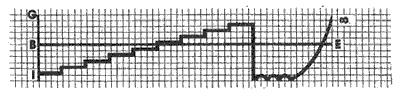
    That’s Kurt Vonnegut‘s theory for why some people “have a need for drama”, as described by Derek Sivers who attended a talk where Vonnegut explained this theory through a series of wonderfully simple diagrams showing the narrative arcs of some of our favourite stories and comparing them to that of a “normal” life.

    Vonnegut also discusses and describes these narrative arcs through diagrams in the collections Palm Sunday and A Man Without a Country. Austin Kleon excerpts the former book, where Vonnegut writes that this was the topic of his rejected Master’s thesis. My favourite arc has to be that of Cinderella:

    Kurt Vonnegut's Narrative Arc Diagram of Cinderella

    On reading this I was curious as to:

    • why the causation must go from the stories we read to our own lives: could it not be that we created stories filled with drama and narrative structures like those described in order to fill a void that the fake dramas we created in real life weren’t?
    • how this could relate to the concept of Apollonian and Dionysian. Not for long, as a quick search led me to Reddit user GhostsForBreakfast‘s thoughts on the idea (basically, what I would like to say, but much clearer).
  • First We Believe, Then We Evaluate

    When presented with a piece of information for the first time, do we first understand the message before carefully evaluating its truthfulness and deciding whether to believe it, or do we instead immediately and automatically believe everything we read?

    In an article that traces the history of this question (Descartes argued that “understanding and believing are two separate processes” while Spinoza thought that “the very act of understanding information was believing it”), an ingenious experiment conducted almost twenty years ago by Daniel Gilbert, author of Stumbling on Happiness, describes how Spinoza was correct: when we first encounter information we believe it immediately and without thought, only to fully evaluate its truthfulness moments later provided we are not distracted.

    Obviously it is important to be aware of this behaviour, as to be distracted while reading critical information of questionable veracity could cause us to not evaluate it fully or at all. However this behaviour has further implications, according to the article, suggesting that this may “explain other behaviours that people regularly display”, including:

    • Correspondence bias: this is people’s assumption that others’ behaviour reflects their personality, when really it reflects the situation.
    • Truthfulness bias: people tend to assume that others are telling the truth, even when they are lying.
    • The persuasion effect: when people are distracted it increases the persuasiveness of a message.
    • Denial-innuendo effect: people tend to positively believe in things that are being categorically denied.
    • Hypothesis testing bias: when testing a theory, instead of trying to prove it wrong people tend to look for information that confirms it.
  • Congruent Conflations in a Thumbnail

    I’ve been going ape-wild for congruent conflations lately and for good reason: they’re the most fun I’ve had with wordplay for a long time and I find they ring off the tongue nicely. Hopefully you’ll cut me a bone if I indulge a little more, as with just a couple more examples you will no-doubt be able to put the dots together.

    Oh, OK, I won’t skirt around the bush any longer; it’s time to let the bean out of the bag with the help of Conflations.com’s introduction to congruent and incongruent conflations (and the accompanying lists thereof):

    Simply put, a conflation is an amalgamation of two different expressions. In most cases, the combination results in a new expression that makes little sense literally, but clearly expresses an idea because it references well-known idioms. All conflations fit into one of two major categories: Congruent ConflationsIncongruent Conflations. Congruent Conflations are the more ideal (and more sought-after) examples of the concept. These occur when the two root expressions basically reflect the same thought. For example, “Look who’s calling the kettle black” can be formed using the root expressions “Look who’s talking” & “The pot is calling the kettle black.” These root expressions really mean the same thing—they are both a friendly way to point out hypocritical behaviour. Of course, without reference to a pot (which is just as black as a kettle), “Look who’s calling the kettle black” does not directly imply anything. Yet the implication is almost automatically understood because the conflation clearly refers to two known idioms.

    Incongruent Conflation occurs when the root expressions do not mean the same thing, but share a common word or theme.

    Congruent example: “Know-it-pants” from the root expressions “Know-it-all” and “Smarty-pants“.

    Incongruent example: “A wild herring” from the root expressions “A wild goose chase” and “A red herring“.

    via @siibo

  • What’s Wrong With ‘Neurobabble’?

    We know that irrelevant neuroscience jargon increases the persuasiveness of arguments, but why is the current trend of finding a neural explanation for much of human behaviour a dangerous thing?

    In his warning against reductionism and trusting in neural explanations for largely psychological phenomenaTyler Burge, Professor of Philosophy at UCLA, describes the three things wrong with “neurobabble” (emphasis mine):

    First, it provides little insight into psychological phenomena.  Often the discoveries amount to finding stronger activation in some area of the brain when a psychological phenomenon occurs.  As if it is news that the brain is not dormant during psychological activity! […] Experiments have shown that neurobabble produces the illusion of understanding.  But little of it is sufficiently detailed to aid, much less provide, psychological explanation.

    Second, brains-in-love talk conflates levels of explanation.  Neurobabble piques interest in science, but obscures how science works.  Individuals see, know, and want to make love.  Brains don’t.  Those things are psychological — not, in any evident way, neural.  Brain activity is necessary for psychological phenomena, but its relation to them is complex. […]

    The third thing wrong with neurobabble is that it has pernicious feedback effects on science itself.  Too much immature science has received massive funding, on the assumption that it illuminates psychology.  The idea that the neural can replace the psychological is the same idea that led to thinking that all psychological ills can be cured with drugs.

    via @mocost