
• The Innovation Deficit

    Disregarding software and much hyperbole (not necessarily mutually exclusive), one might think that recent times have been an innovation desert. This is the opinion of Newsweek’s Michael Mandel who believes that the lack of innovation over the past decade may be responsible for America’s economic situation.

    There’s no government-constructed “innovation index” that would allow us to conclude unambiguously that we’ve been experiencing an innovation shortfall. Still, plenty of clues point in that direction. Start with the stock market. If an innovation boom were truly happening, it would likely push up stock prices for companies in such leading-edge sectors as pharmaceuticals and information technology.

    Instead, the stock index that tracks the pharmaceutical, biotech, and life sciences companies in the Standard & Poor’s (MHP) 500-stock index dropped 32% from the end of 1998 to the end of 2007, after adjusting for inflation. The information technology index fell 29%. […]

    Consider another indicator of commercially important innovation: the trade balance in advanced technology products. […] In 1998 the U.S. had a $30 billion trade surplus in [life sciences, biotech, advanced materials, and aerospace]; by 2007 that had flipped to a $53 billion deficit. […]

    A more indirect indication of the lack of innovation lies in the wages of college-educated workers.

    via @jakeybro

    Somewhat related: this week the 2009 State of Innovation Summit was held in Washington DC. “Commentary” from John Wilbanks (runs the Science Commons project at Creative Commons) and from Bioephemera’s Jessica Palmer.
  • Female Sexuality Research: What Women Want

    The question ‘What does a woman want?’ was, according to Freud, “The great question that has never been answered”. One person trying to answer this question, however, is Meredith Chivers—a psychologist specialising in sexual behaviour whose work was extensively discussed in The New York Times earlier this year.

    The article, focusing on female sexuality, is eye-opening in many ways, especially in showing the gulf between male and female sexuality.

    The men, on average, responded genitally in what Chivers terms “category specific” ways. […] The men’s minds and genitals were in agreement.

    All was different with the women. No matter what their self-proclaimed sexual orientation, they showed, on the whole, strong and swift genital arousal when the screen offered men with men, women with women and women with men. […] With the women, especially the straight women, mind and genitals seemed scarcely to belong to the same person.

    via Green Oasis

  • Economic Experts: Insightful, Biased

    Be wary of advice and forecasts from economic ‘experts’, says economist Zachary Karabell—not because they are trying to sell their services or because they are lying, but because they truly believe their (unintentionally) skewed opinions.

    Being wrong in the past is not much of a liability as long as one is right in the present. […]

    There may be “experts” who knowingly skew their analysis to serve their own bottom line. But I believe they are rare. The issue is less the integrity of those selling their wares than the market forces that choose them. When times are good and people feel confident, experts who support that view find more traction—and more demand—than those who don’t. When times turn troubled, as they most certainly are now, those whose perspective rhymes with the prevailing gloom appear wiser than those who do not.

    Prominent experts, therefore, are often simply those whose voices are in harmony with today’s mood and who have an easier time selling their stories. That doesn’t mean that the analysis is inherently flawed—only that it is inherently market-driven.

    Obvious, but it’s good to have this reiterated every now and again.

  • Don’t Implement Ideas, Solve Problems

    Taking inspiration from Paul Graham’s Ideas for Startups essay, Martin Zwilling offers some further thoughts—to wit, don’t start with an idea, start with a problem.

    Potential startup founders are always looking for ideas to implement, when they should be looking for problems to solve. Customers pay for solutions, and there is no market for ideas. I’m often approached by people with a “million dollar idea,” but I haven’t seen anyone pay for one of these yet.

  • Entrepreneurs Not Learning From Mistakes

    Entrepreneurial failure is an integral part of eventual success and an important opportunity for learning, or so goes the conventional wisdom (hence in some part the quote—commonly attributed to Lisa Amos—that entrepreneurs average 3.8 failures before success).

    Ignoring the anecdotal success-after-failure stories that stick in peoples’ minds, a team at Harvard Business School decided to quantitatively study entrepreneurial failure and success rates and discovered that, contrary to popular belief, entrepreneurs don’t seem to learn from failures, and success is the only experience that made a difference to performance.

    First-time entrepreneurs who received venture capital funding had a 22 percent chance of success. Success was defined as going public or filing to go public; […] results were similar when using other measures, like acquisition or merger.

    Already-successful entrepreneurs were far more likely to succeed again: their success rate for later venture-backed companies was 34 percent. But entrepreneurs whose companies had been liquidated or gone bankrupt had almost the same follow-on success rate as the first-timers: 23 percent.

  • How Language Affects Thinking

    Linguistic relativity is the idea that language differences alone can affect how we perceive world experiences and thus can cause us to behave differently.

    In an Edge essay, Lera Boroditsky discusses some of her research into linguistic relativity and how language use (grammar, word choice and language itself) vastly alters our perceptions and thought processes, offering some interesting examples.

    Even basic aspects of time perception can be affected by language. For example, English speakers prefer to talk about duration in terms of length (e.g., “That was a short talk,” “The meeting didn’t take long”), while Spanish and Greek speakers prefer to talk about time in terms of amount, relying more on words like “much” “big”, and “little” rather than “short” and “long” Our research into such basic cognitive abilities as estimating duration shows that speakers of different languages differ in ways predicted by the patterns of metaphors in their language. (For example, when asked to estimate duration, English speakers are more likely to be confused by distance information, estimating that a line of greater length remains on the test screen for a longer period of time, whereas Greek speakers are more likely to be confused by amount, estimating that a container that is fuller remains longer on the screen.)

    via Mind Hacks

  • In Defence of Branding

    By comparing and contrasting the “two worlds” of direct marketing and brand marketing, Andrew Chen discusses why metrics-driven marketing shouldn’t usurp that of ‘branding’.

    The nature of internet marketing makes it easy to have a highly accountable, metrics-driven view – but companies that are highly metrics driven easily overlook hard-to-measure issues like brand and user experience. The reason is that when all product decision-making is run through metrics-driven reports, soft things like “Brand” show up as costs, but never as benefits.

    This leads to systematic erosion in many “soft” but important factors, like customer experience, brand value, and “love.” And ultimately you need all of these things to create a massive, enduring consumer brand – it’s not enough to optimize funnels.

  • Prosperity, Freedom, Fertility

    When it comes to reproduction, are individuals who strive only for personal gain—as Adam Smith stated in The Wealth of Nations—”led by an invisible hand […] to promote the public interest”?

    In The Tragedy of the Commons, ecologist Garrett Hardin suggested not and called for further government intervention to help control rising populations.

    Recent studies, however, are suggesting that the current laissez-faire approach to reproduction in developed and economically ‘free’ countries does lead to an optimal population. (As always, there are caveats.)

    In 2002, Seth Norton, a business economics professor at Wheaton College in Illinois, published a remarkably interesting study on the inverse relationship between prosperity and fertility. Norton compared fertility rates of over 100 countries with their index rankings for economic freedom and another index for the rule of law. “Fertility rate is highest for those countries that have little economic freedom and little respect for the rule of law,” wrote Norton. “The relationship is a powerful one. Fertility rates are more than twice as high in countries with low levels of economic freedom and the rule of law compared to countries with high levels of those measures.”

    Norton found that the fertility rate in countries that ranked low on economic freedom averaged 4.27 children per woman while countries with high economic freedom rankings had an average fertility rate of 1.82 children per woman. His results for the rule of law were similar; fertility rates in countries with low respect for the rule of law averaged 4.16 whereas countries with high respect for the rule of law had fertility rates averaging 1.55.

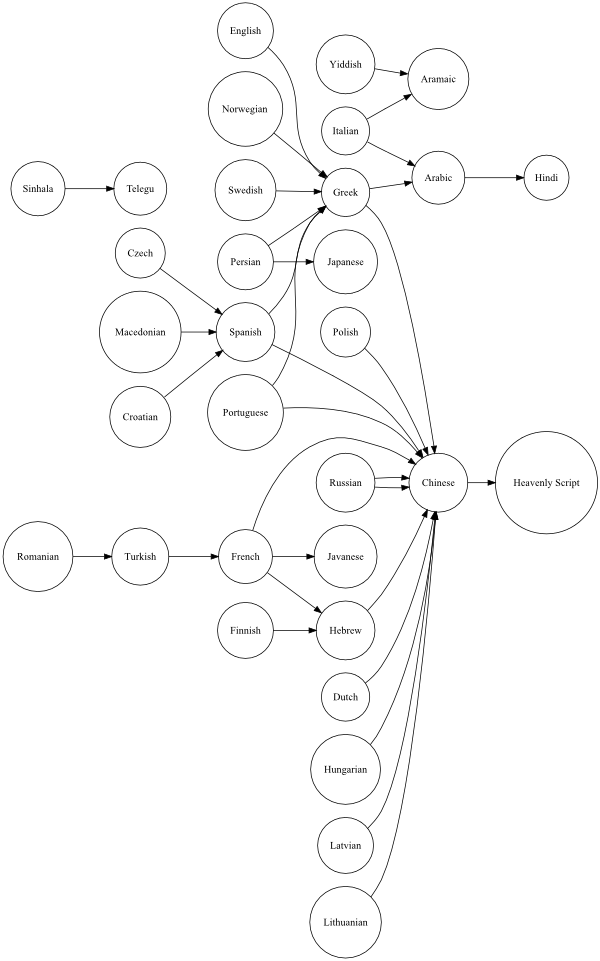
  • Language Incomprehensibility Flowchart (It’s All Greek To Me)

    Language Log was asked;

    When an English speaker doesn’t understand a word one says, it’s “Greek to me”. When a Hebrew speaker encounters this difficulty, it “sounds like Chinese”. […] Has there been a study of this phrase phenomenon, relating different languages on some kind of Directed Graph?

    To answer the query, Mark Liberman checks out Wikipedia’s ‘Greek to me’ entry (among other sources) and produces a rather elegant directed graph depicting what languages are stereotypically incomprehensible to others.

    The accompanying discussion is also noteworthy. As one commenter points out, the fact that the resulting directed graph is acyclic implies a sort of ordering or hierarchy of language incomprehensibility.

    via Kottke

  • Adoption and Abandonment of Tools and Ideas

    Jason’s post discussing economist Lant Pritchett’s thoughts on how people perceive ‘game-changing ideas’ over time

    Crazy. Crazy. Crazy. Obvious.

    Or, more eloquently:

    Silly, controversial, progressive, then obvious.

    reminded me of research on the rise and fall of an item’s popularity that found the fall mirrored the rise.

    According to the results, the quicker a cultural item rockets to popularity, the quicker it dies. This pattern occurs because people believe that items that are adopted quickly will become fads, leading them to avoid these items, thus causing these items to die out.

    And how did the researchers investigate these cultural ‘taste changes’ over time? By analysing the rise and fall in popularity of different baby names over the past 100 years, of course (“because there is less of an influence of technology or advertising on name choice, baby names provide a way to study how adoption depends on primarily internal factors”).

    This also reminds me of Peter Feld’s First Law of Metatwitter:

    The more a platform is used to talk about itself, the greater the barriers to its adoption beyond its core users.