
• The Final Salute: A Touching Story

    They are the troops that nobody wants to see, carrying a message that no military family ever wants to hear.

    It begins with a knock at the door.

    Final Salute is a double Pulitzer Prize winning article (writing and photography) from The Rocky Mountain News profiling the work of Major Steve Beck – a US Marine responsible for notifying family members of a Marine’s death. As the Pulitzer Award cited, the article is a “haunting, behind-the-scenes look”.

    It’s long; but it’s worthy of every moment of your time no matter what your stance on the numerous armed conflicts currently under way. It’s a difficult read that will put a lump in your throat.
    (Alternative link)

  • The Warren Buffett Guide to Investing

    In Picking Warren Buffett’s Brain: Notes from a Novice, Tim Ferriss shares the notes he took at a recent convention for Berkshire Hathaway shareholders. It’s an interesting read and here’s the crux of it all:

    How would you invest your first million dollars?

    “I’d put it all in a low-cost index fund that tracks the S&P 500 [UK equiv: FTSE All-Share] and get back to work…”

    Why do people struggle with this simple investing concept? Because people believe the experts, and when you pay the experts for advice… well, I’ll let Warren continue:

    “No one will give you this advice [index funds] because no one gets paid for it.”

    How about the best books to read “for investing and life”?

    • Buffett: Chapters 8 and 20 in The Intelligent Investor.
    • Munger (Vice-Chairman, Berkshire Hathaway): Anything by Ben Franklin.
  • Bananas: An Atheist’s Nightmare, and the Scourge of United Fruit

    The Banana: An Atheist’s Nightmare is a video I’ve seen linked in numerous places. I think this video nicely sums up Intelligent Design’s ignorance arguments.

    God exists because bananas fit well in the human hand and peel easily.

    • First: Hahahahaha!
    • Second: Peels easily? Are we ignoring the fact that – if anything – the banana is ‘designed’ more for primates (for whom the banana is a primary source of nutrients) than for humans? Primates peel bananas using a much superior method that differs significantly to the typical way in which humans do… a method that I have recently adopted.
    • Third: Bananas are designed – the banana we all know and love is a manufactured product – a product that is under threat because of this.
    • Fourth: Hahahahaha!

    via kottke and LinkBanana

  • 2008 Reith Lectures – Chinese Vistas

    If you haven’t yet discovered, the 2008 Reith Lectures are currently under way over at BBC Radio 4. This year they are being held by Jonathan Spence – a specialist in Chinese history – and the first two lectures have been on the topics of Confucius and UK-China relations.

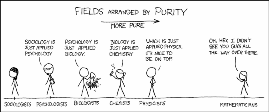
  • The Purity Scale of Science (xkcd)

    xkcd - Purity ScaleThis is for those of you who aren’t subscribers to my favourite comic, xkcd – a webcomic of romance, sarcasm, math, and language.

    Today’s episode deals with different branches of science and their purity; that is, can they be distilled down to a ‘more pure’ science.

    Maths is classed as the purest of sciences – of course – but where does computing lie? I’d like to think it lies alongside physics, but in reality I imagine it is along a different branch involving applied electronics (itself, applied physics).

    Don’t forget, each xkcd comic has image ‘alt’ text… essentially a bonus joke on those tiresome Monday, Wednesday, and Fridays! (Today’s is especially good.)

  • 10 Ways We Get Things Wrong

    Psychology Today has an interesting article on fear, probability, and how we get things wrong. It’s not a very scannable article, so here’s an executive summary:

    1. We Fear Snakes, Not Cars – Risk and emotion are inseparable
    2. We Fear Spectacular, Unlikely EventsFear skews risk analysis in predictable ways
    3. We Fear Cancer But Not Heart DiseaseWe underestimate threats that creep up on us
    4. No Pesticide in My Backyard—Unless I Put it ThereWe prefer that which (we think) we can control
    5. We Speed Up When We Put Our Seatbelts OnWe substitute one risk for another
    6. Teens May Think Too Much About Risk—And Not Feel EnoughWhy using your cortex isn’t always smart
    7. Why Young Men Will Never Get Good Rates on Car InsuranceThe “risk thermostat” varies widely
    8. We Worry About Teen Marijuana Use, But Not About Teen SportsRisk arguments cannot be divorced from values
    9. We Love Sunlight But Fear Nuclear PowerWhy “natural” risks are easier to accept
    10. We Should Fear Fear Itself – Why worrying about risk is itself risky
  • Randall Munroe (of xkcd) Visits Google

    I absolutely, positively, know I’ve written about this and I would bet my life savings that I posted it, but alas I cannot find it anywhere.

    Every-so-slightly delayed (months later!), here’s what happened when Randall Munroe (of xkcd fame) was invited to Google – he also gave an Authors@Google talk.

    More Googleplex videos here, including the excellent Tech Talks that I can’t get enough of.

  • Japan Travel

    Hoping to have an extended visit to Japan in the near future? You may be as pleased as I was when I stumbled upon a site offering 10 Japanese Customs You Must Know Before a Trip to Japan.

    A perfect compliment to Tim Ferriss’ Hacking Japan: Inside Tokyo for Less Than New York (part two).

    I’ll be double-checking facts with my brother (who lives in Tokyo) and if there are any anomalies will be posting them here. Seems promising though.

    Also: 10 Reasons Japan is Better Than America

  • 5 Years On the Road – A Hitchhiking Story

    Ludovic Hubler is a Frenchman who, in 2003, set off around the world with one goal – to travel all of it by hitchhiking.

    This is it ! The circle has finally been closed. 5 years, passed day by day since leaving the Alps, and now here I am back at my point of departure, at the same place I left on January 1st, 2003. When I started out I was 25 years old. Now I’m 30.

    This personal account of his experience is a must-read for the intrepid traveller in all of us; a fascinating account complete with philosophical musings and statistics on his journey. He has two words for the world: “never again”… but it’s not what you think!

  • The Omega Point

    The Singularity again, but this time a Gravitational (or Spacetime) Singularity. Specifically the one at the end of existence of the universe.

    The Omega Point is the moment during the theoretical Big Crunch when – just before the final, all-ending gravitational singularity – “the computational capacity of the universe is capable of increasing at a sufficient rate that is accelerating exponentially faster than the time running out.” What exactly does that mean?

    In principle, a simulation run on [a theoretical] universal computer can continue forever in its own terms, even though the universe lasts only a finite amount of proper time. This theory requires that the current known laws of physics are true descriptions of reality, and it requires there be intelligent civilizations in existence at the appropriate time to exploit the computational capacity of such an environment.

    An enlightening read that pushes the bounds on the meaning of the word ‘theoretical’. However, it did lead me to a contender for ‘The Greatest Named Wikipedia Entry‘ competition: The Ultimate Fate of the Universe.